01 BarTrack 02 Nissan 03 Big Tech Client 04 Southwest 05 naviHealth 06 HCA
Case Study 03 — Big Tech Client

Engineering Onboarding for a Big Tech Client

Client
A Big Tech Client — Ad Platforms Engineering
Role
Design Lead / Client Whisperer

This Big Tech client's Ad Platforms org was hiring engineers fast — faster than its onboarding experience could keep up with — and needed a portal that lived up to the client's best-in-class reputation, not an afterthought bolted onto it. I was brought in to rescue a failing project and a damaged client relationship. Given my prior experience with this client, my strategic approach, and my ability to read and steady a difficult client situation, I was asked to take the work over and lead the existing team through it, rebuilding the relationship along the way.

3 Weeks
Of Silence Before Day One
No Manager Check-In
No Peer Introduction
No Sense of What Was Coming
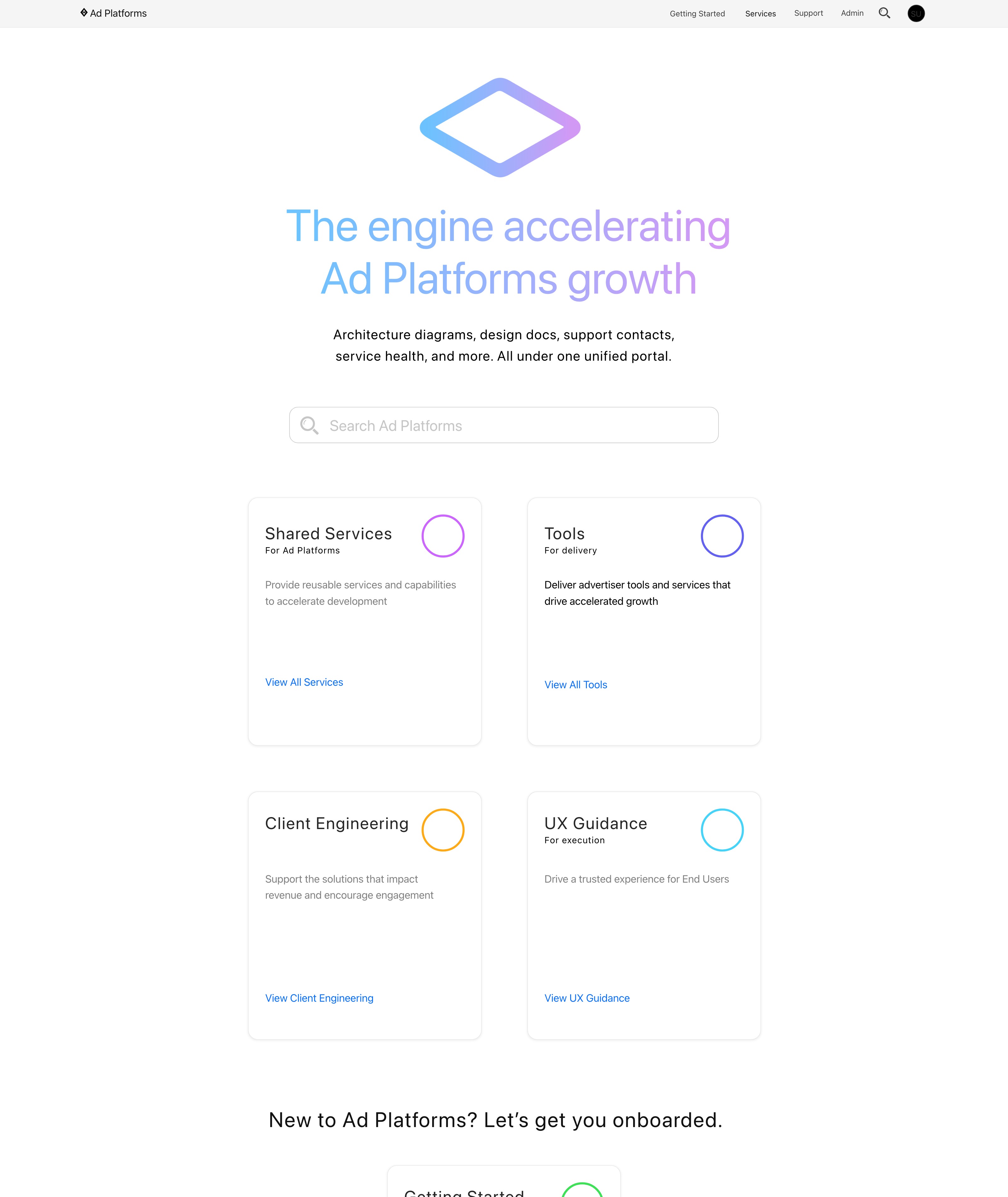
Ad Platforms engineering portal homepage — architecture diagrams, shared services, and tools all in one place
The Platform · Unified Internal Homepage for the Org
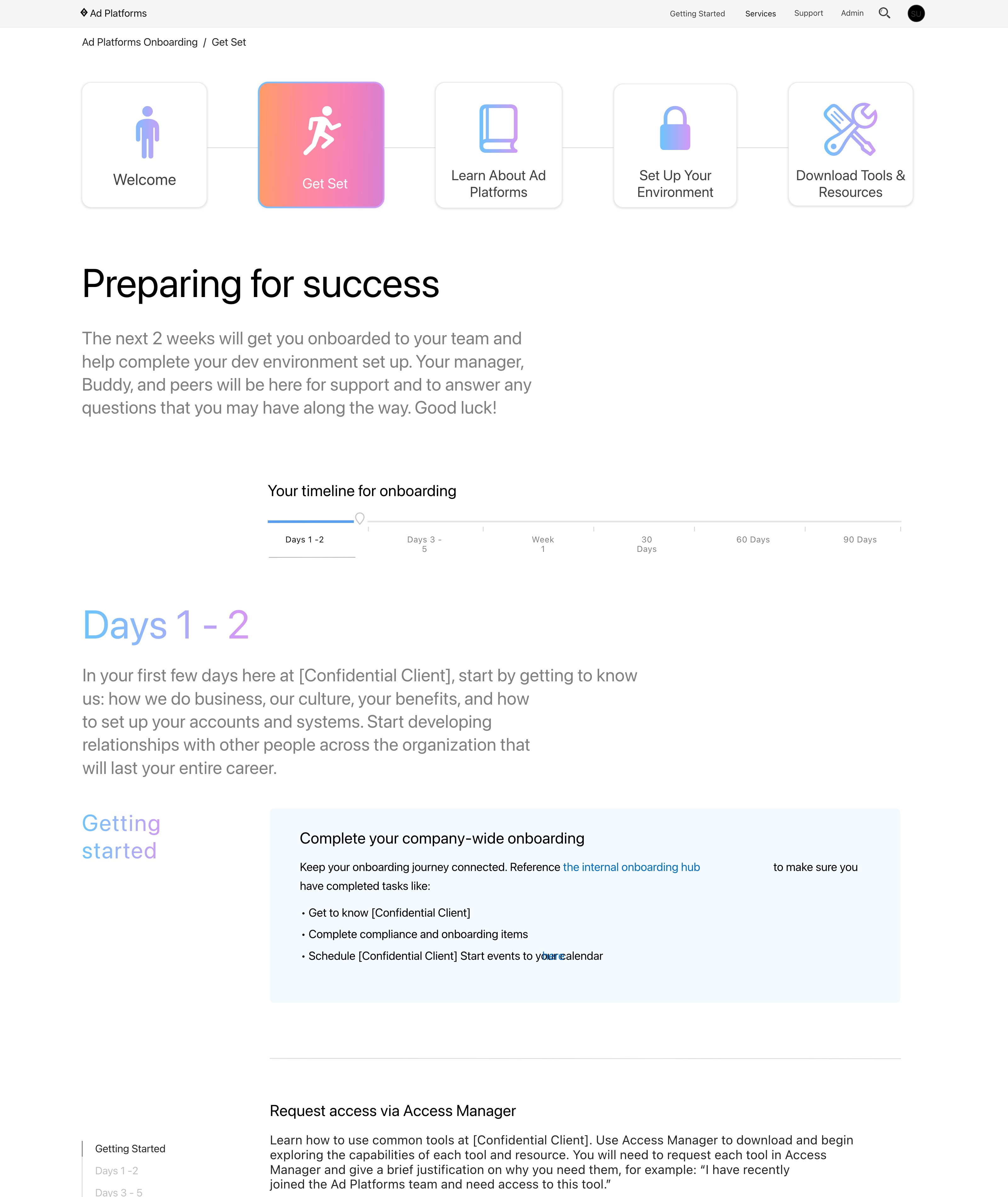
Ad Platforms onboarding wizard Get Set step showing a five-step progress tracker and onboarding timeline
The Onboarding Experience · Personalized Wizard Inside It
Research

What we heard, and the pattern underneath it.

  • Leadership wanted to proactively improve the experience so engineers could do the best work of their life
  • A real desire to stand up a durable onboarding capability, aligned to OKRs
  • Onboarding was the priority — an earlier attempt had produced recommendations that mostly sat on a shelf
  • Interviews surfaced real back-end and process gaps — this was a service design problem as much as a UX one

The pattern was consistent: new hires got their offer letter, then heard nothing for three weeks — no check-in from a manager, no introduction to a peer, no sense of what was coming. For engineers who'd chosen a career built on process and structure, that silence didn't read as low-key. It read as something being wrong.

"I didn't hear from them for so long that I thought it might have been a scam and I wasn't actually an employee there." — New Hire
"From setting up your laptop to meeting people, most of the onboarding experience is self-service." — Experienced IC
"I had only met my manager once briefly in the first week, but it was great to meet the team." — Inexperienced IC
Artifact

Mapping three personas across a six-month arc.

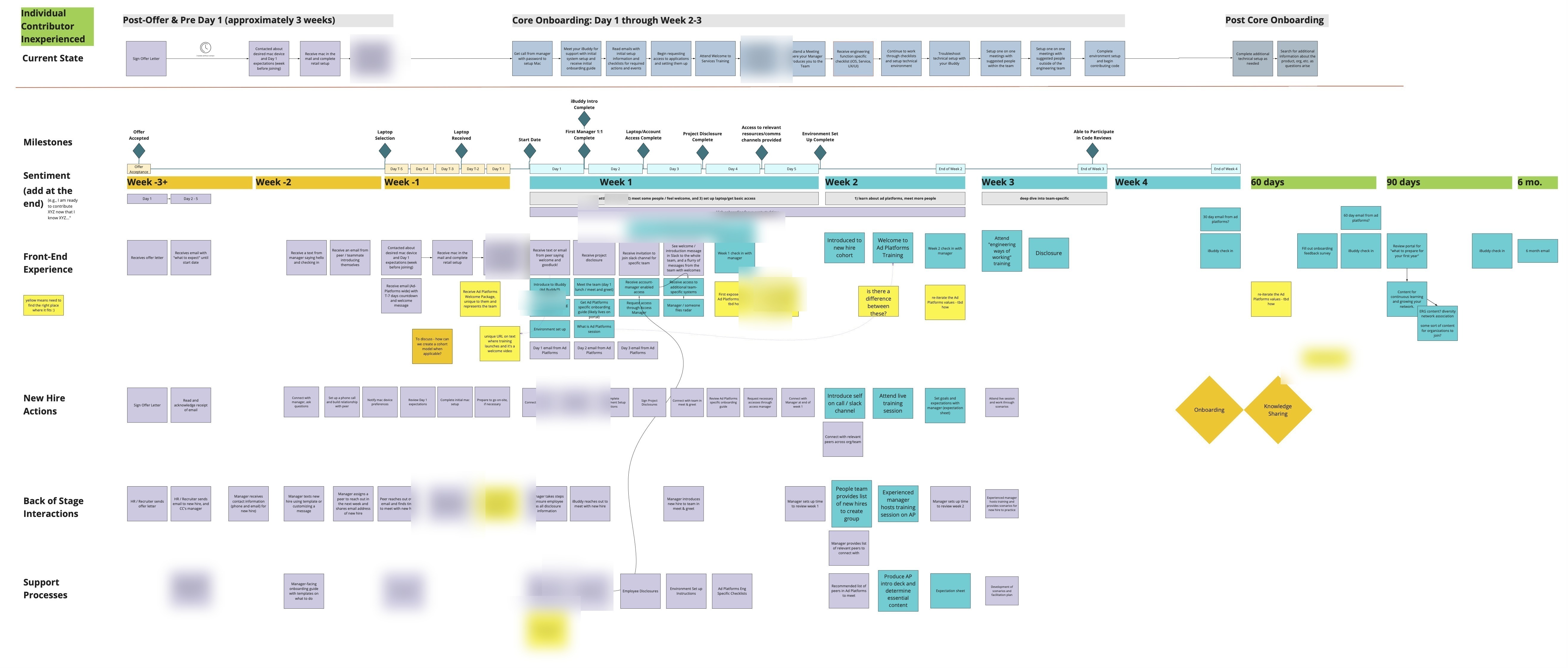
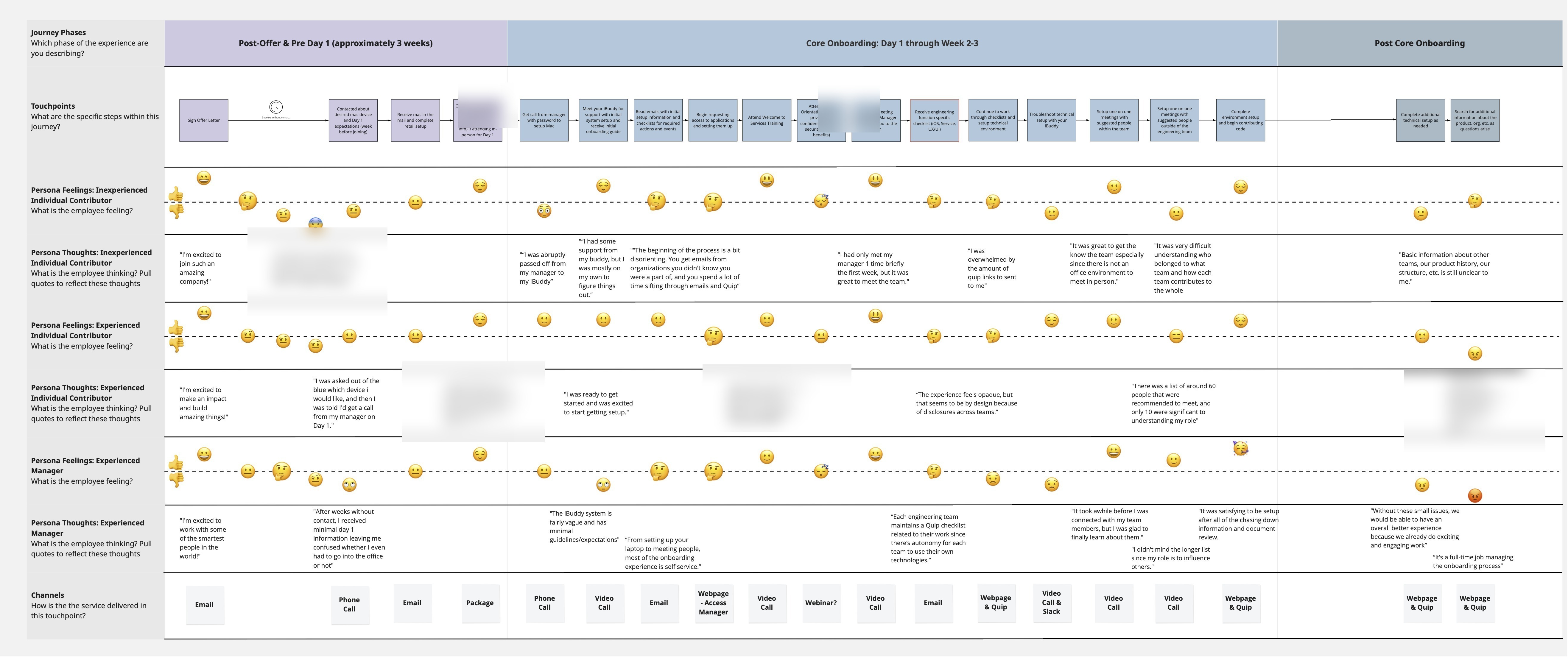
The journey map tracked three personas at once — Inexperienced IC, Experienced IC, and Experienced Manager — from Post-Offer through Post-Core Onboarding. A manager's memory of "a great week 1" sat right next to a new hire's memory of "it took a while to be connected." Same event, two different stories.

Some details in the artifacts below have been redacted to protect client confidentiality.

Onboarding journey map across three personas
Artifact · Journey Map
Onboarding service design blueprint
Artifact · Service Design Blueprint
Pivot

Mentors don't show up on Day 1. The system does.

Early thinking assumed mentors would step in during the first days, easing new hires into the team and the work. Interviews showed otherwise: mentors typically didn't enter the picture until later. That gap meant the earliest, most disorienting stretch of onboarding had to be carried by the system itself, not a person.

That's why the onboarding portal moved from a nice-to-have to one of the Bigger Bets. It exists to do a mentor's job until an actual mentor shows up.

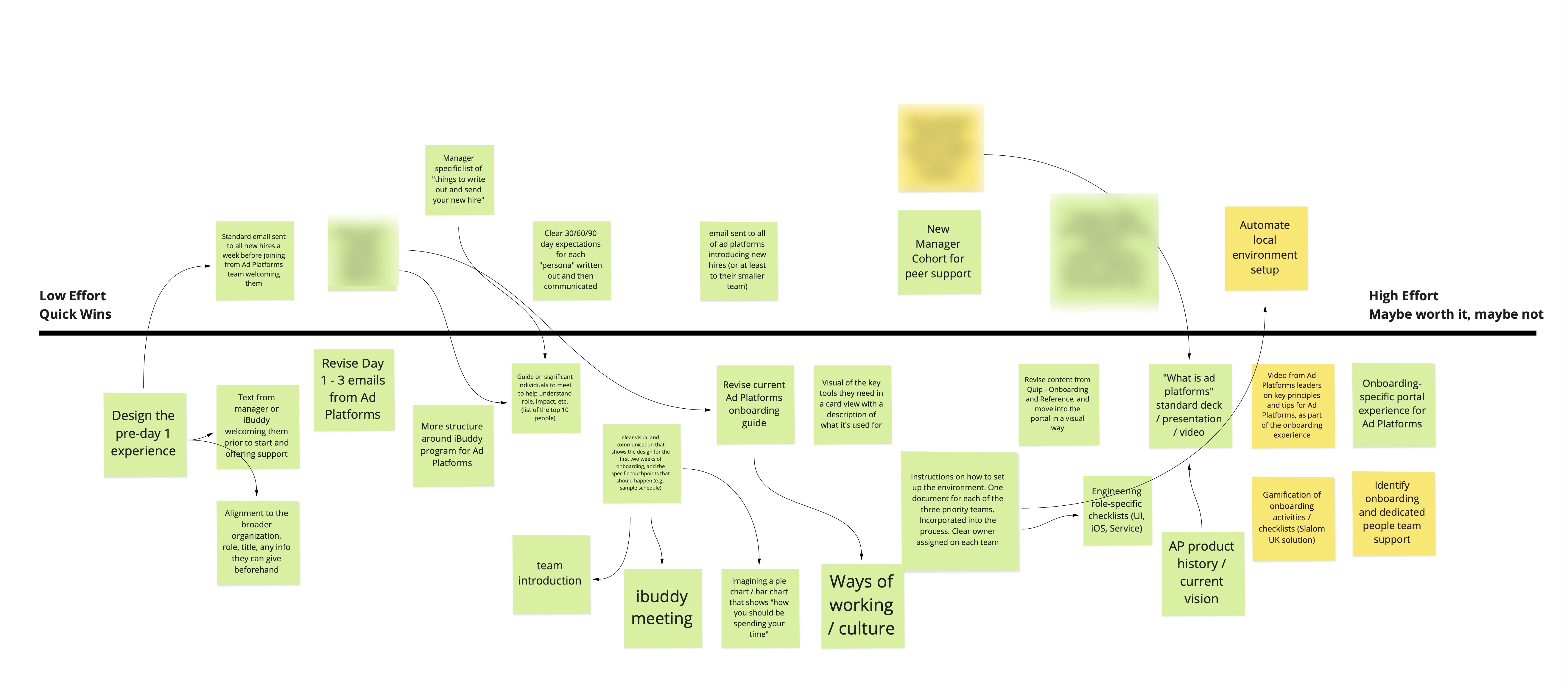
Onboarding prioritization matrix
Artifact · Prioritization Matrix — 25+ Opportunities
Approach

Quick wins and bigger bets.

With the gaps mapped, we prioritized opportunities on an effort vs. impact matrix — separating what could move the needle right away from what was worth a bigger investment.

  • Quick Wins: a standard welcome email before Day 1, a text from the manager or onboarding buddy, written 30/60/90-day expectations for each persona
  • Bigger Bets: the onboarding portal itself, gamified checklists, automation of local dev-environment setup — the most friction-heavy part of week one
The Design

Two layers: the platform, and the personalized wizard inside it.

New hires were greeted by name and walked through a five-section roadmap — from setting up their laptop to their first code review. Warm without being saccharine, unmistakably on-brand for the client without borrowing its consumer design language.

Live prototype  ·  explore the full onboarding roadmap
→ Open full-screen in a new tab
Outcome

The project didn't ship. The relationship did.

The project lost funding as we were completing the designs — that happens in enterprise work, and no amount of good design insulates you from it. But the rigorous methodology, the deep understanding of user needs, and the relationship rebuilt with a difficult client made this one of the most valuable engagements of my career.

Next

04 — Southwest Airlines

Continue to the next case study.

→ View Southwest Airlines
Switch Experience
Bauhausian Classic Hacker Neo-Brutalist Punk Zine